

How to choose your tennis strings
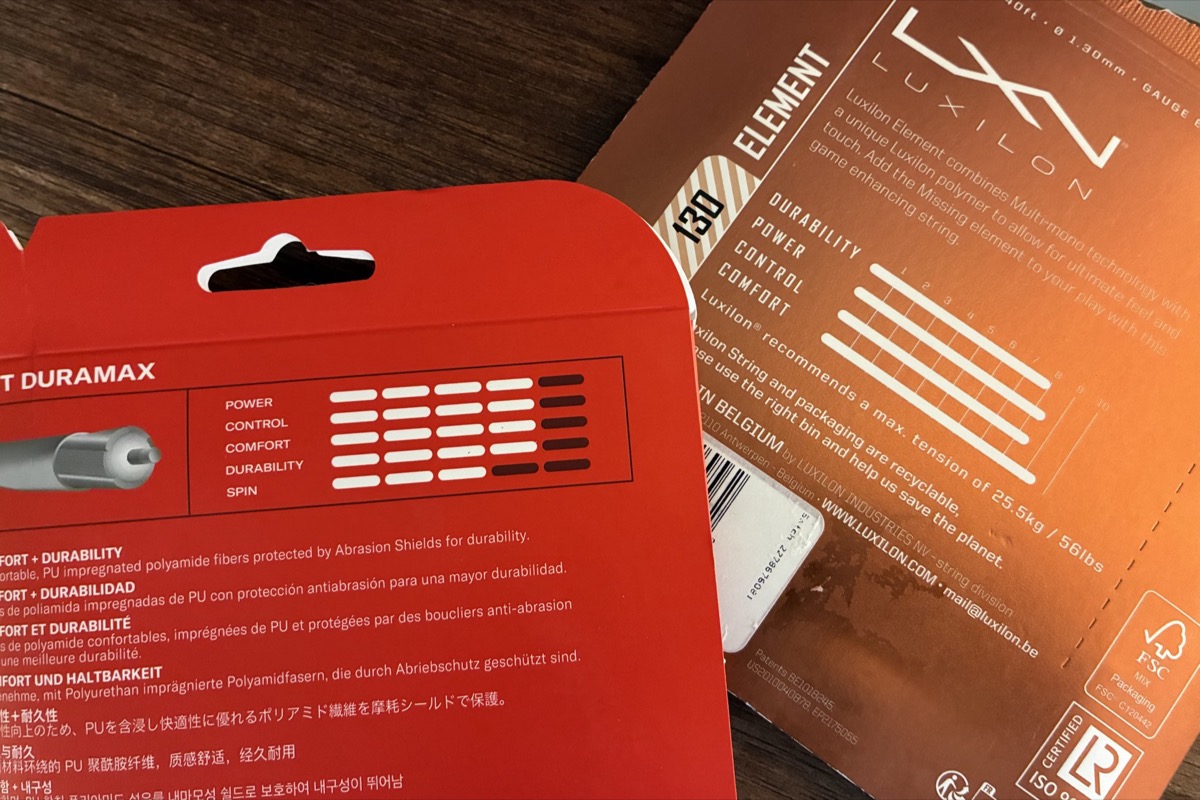
You are at the club counter asking for recommendations on racquet strings. Behind the counter is the display wall: forty packets from different brands, and they all look the same except for the colors. So you are thinking of your favorite colors, or whatever matches the racquet, or the neon pink half the courts seem to be using this summer.
It depends on who is working the counter. The patient staff walk you through a few options. The busy staff pick something safe, knowing you will not argue. And sometimes they simply take you at your word: you said more control, more spin, less power, so they hand you a seriously advanced string without knowing you started playing a few weeks ago.
We started playing tennis at our club and the staff knew we were beginners. So they picked a Wilson NXT Comfort 17 in neutral color and closed the sale with "Trust me, you want this color." We have tried every color since, and settled on the neon orange, the happy color.
Do strings matter that much, and where would you even start? We all asked the same questions once. Here is what we learned.
Every string is measured the same way
Every packet and product page lists the same standard specs: composition, gauge, length, and color.
Composition is the material and construction. Gauge is thickness: 16 (1.30 mm) and 17 (1.25 mm) are common options. A thinner string plays livelier and bites the ball harder but breaks sooner, and a thicker one lasts longer.
Length is standard. A packet is enough for one restring, and a reel is enough for about 16. Only buy a reel once you have settled on a specific string.
And color, the spec most of us actually shop by, changes nothing about how the string plays.
Then come the string "function" ratings: power, control, spin, comfort, durability. Some packets print scores for them. Use them as a rough guide to what suits your play.
The four main string families
Polyester is a single solid strand of stiff plastic. Pros love this string for spin and control: the mains slide sideways under the ball and snap back, though it gives back the least free power. Big topspin hitters and string breakers live here.
It is durable, but it is also the stiffest common string, and it loses tension faster than anything else up there. Be prepared to restring much more often to keep the performance.
Multifilament is hundreds of fine fibers twisted and bonded into one string, built to imitate gut. It is soft with more free power, but less control and spin. It wears like a rope, fraying until it snaps.
It holds tension relatively well, so you can play it until it breaks without a drastic drop in performance. Heavy hitters, on the other hand, go through it quickly.
Natural gut is the softest string made and the best at holding tension, with only the price tag, often north of $40 a set, left to argue about.
Synthetic gut is a solid nylon core with a wrap around it. It mimics natural gut at a fraction of the price, often under $10 a set. At this price, brand names do not matter.
Kevlar also exists. It is the stiffest string on the wall by a distance, and unless you break strings weekly and your arm has never complained about anything, it is not for you.
String tension
After picking your strings, the next important question is the tension you want. Your racquet should have a recommended range printed on the frame, usually somewhere around 50 to 60 lbs, and many string packets list their own recommendation too.
Start in the middle. Lower tension plays softer and launches the ball more, higher plays firmer with less launch, and polyester is usually strung a few pounds below the packets' recommended number.
If you are starting out with soft strings like multifilament or gut and you have no arm or shoulder issues, go with the middle plus 1 or 2 lbs. If you are concerned about vibrations, drop below the middle instead.
Some players also split tensions between the mains and the crosses, usually a couple of pounds apart, to fine-tune the feel. It pairs naturally with the hybrid setups.
How to choose yours
Brand new, no preference yet: start with multifilament, for comfort, durability, and of course the wallet.
Elbow or shoulder history: multifilament, or gut if the budget stretches. Forget about poly. No spin advantage is worth playing hurt, and we have cut a set out mid-season for the arm's sake.
Hard hitter, heavy topspin, or string breaker: polyester. Players with high racquet head speed can always benefit from poly. Just pay attention to the tension loss, since poly goes quietly while still looking new, which is why we wrote a whole post on it.
Play a few times a month: anything but poly. All of the other strings are fine sitting on the racquet for a long time. Fine is underrated. Do not fix what is not broken.
Poly-curious but not committed: try a hybrid. String poly in the mains, where spin is made, and multifilament or gut in the crosses, where comfort lives, and you get most of both. It is the most common compromise in tennis for a reason. One of us logged a full run of one: poly mains and multi crosses at 54 lbs gave 37 hours of good tennis, and the same setup strung at 56 lbs taught the arm lesson above in 15.
Track your own string journey
Whatever you choose will die on you eventually. Multis and gut fray and snap in plain sight, poly goes quietly while looking new, and when to restring is our full answer on the schedule.
So start with the set in your racquet right now: the string and the tension, one minute in StringLog. Rate the feel after you play, and next restring you are not guessing at the counter. You are reading your own notes.