

When to restring your tennis racquet
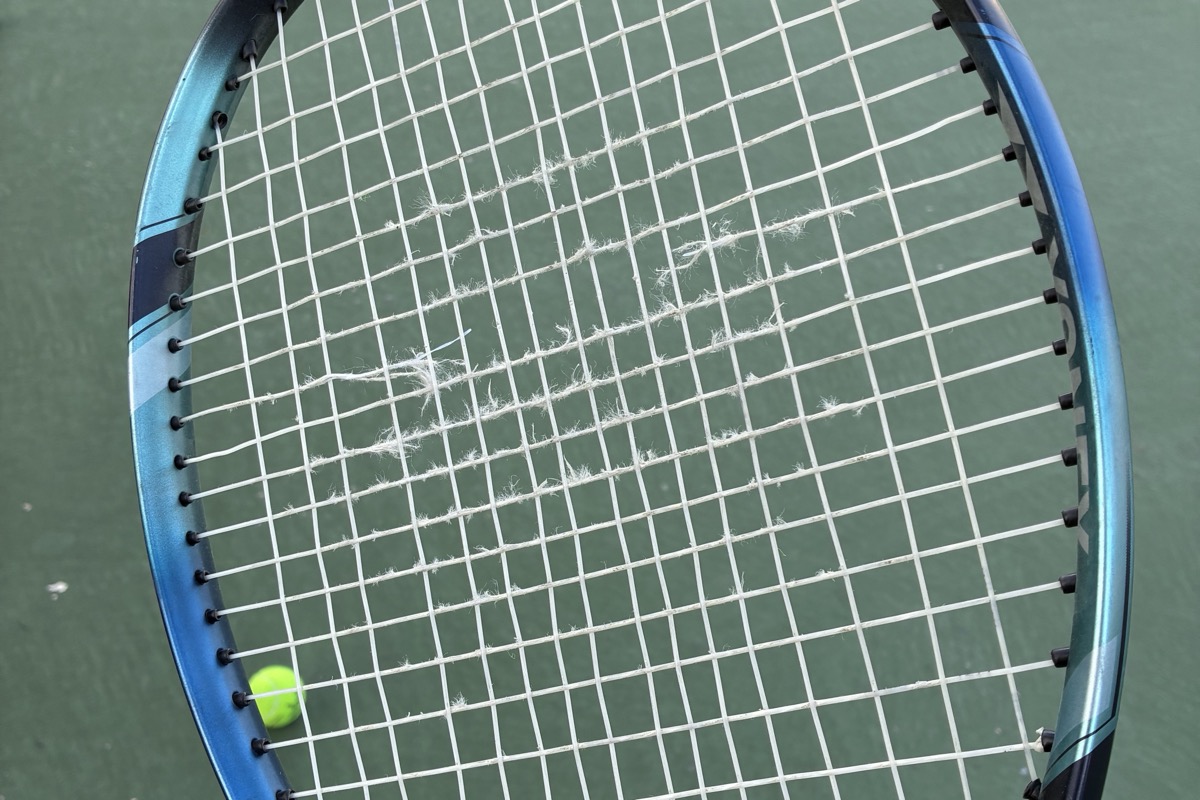
We have all heard the old rule of thumb, repeated across stringing guides and pro shops: change your strings as many times in a year as you play in a week, with once a year as an absolute minimum. However, it is not always obvious why you would restring when the strings still look fine and felt fine last week. Ask why, and nobody gives you a straight answer.
Dead strings cost you more than a few bad points. As a string loses tension, the ball may start sailing long. Without realizing the strings are to blame, you instinctively compensate: shortening your swing, easing off your leg drive, or choking off your follow-through just to keep the ball in court. You end up grooving bad habits to fix a problem your equipment is causing.
On top of that, players commonly report that a dead bed feels harsher on the arm, a concern worth taking seriously, even if it is not a settled finding. We would rather restring early than late.
So, how do you start paying attention to what your strings are actually telling you?
Know your strings
Not all strings die the same way. The four common materials on the market fall into two distinct camps: strings that tell you they are spent, and strings that lie.
If you are new to this or haven't paid much attention to your setup, start with multifilament. Multis hold tension well, offer arm-friendly comfort, and play consistently from day to day. Best of all, they fail honestly: they fray, notch, and eventually snap, giving you a clear visual signal that it's time for a fresh set. The full pick-a-string decision is in how to choose your tennis strings.
Synthetic gut and natural gut round out the same honest camp, though they wear differently. Synthetic gut is built around a solid nylon core, so it doesn't fuzz up like a multi; instead it notches, sawing deep grooves where the strings cross until it snaps clean. Natural gut is made from livestock fiber and is the benchmark for comfort and tension retention. Woven from raw individual strands, it frays into a fuzzy texture as it wears, the exact same visual cue as a multi.
All three show their age where you can see it. Polyester is the exception, the trickier and more deceptive case. It loses tension faster than almost any other material, yet it rarely breaks for average hitters. A poly bed can be completely dead while looking brand new in your frame. That silence is precisely why you can't rely on an eyeball test.
The tension starts dropping the moment it's strung
Strings lose tension the second they leave the stringing machine. Tennis Warehouse University's dead-strings testing clocks up to 15 lbs lost in the first minute, and a 2000 lab study by Rod Cross, Crawford Lindsey, and Daniel Andruczyk matches: a racquet strung at about 62 lbs falls to around 53 lbs within 20 minutes, roughly the time the stringing itself takes, and sits near 44 lbs a day later.
That is nearly a 30% drop in tension within a single day, most of it before your first real session, and you will feel none of it.
The signs to watch for (if using poly strings)
Browse any classic Talk Tennis thread on how to tell when poly goes dead and the exact same warning signs pop up repeatedly:
- Stuck main strings: The mains stop snapping back into place, forcing you to straighten them between points.
- Erratic feel: The stringbed suddenly feels stiff as a board, or worse, completely mushy.
- Dead sound: A dull, hollow thud on contact instead of a crisp, clean ping.
- Loss of control: Shots that used to drop safely inside the baseline suddenly start sailing long.
Tennis.com's Jon Levey lands on the same test: needing to straighten strings between points is the clearest signal. As he puts it: "You're always better off cutting out a poly too early, rather than too late."
Why there is no single number
You may have heard that poly dies at about 10 hours. The same Talk Tennis thread that lists the cues shows that reported poly lifespans run from 2 to 4 hours at one end to 15 to 20 hours at the other, a fivefold range, all from players describing the same failure.
We have seen it in our own log. The same poly/multi hybrid on the same racquet lasted 37 hours at 54/54 lbs, then 15 hours at 56/54, 2 pounds apart on the mains. Same strings, same racquet, same player, and the hour count more than halved. There is no single number to reach for, only your own setup and how it plays.
Find your own number
The honest answer to "should I restring yet" is never an arbitrary date on a calendar or someone else's hour count. It is a trend in how your racquet actually performs in your hand. Your strings are done when your own feel ratings start falling.
Log your setup, jot a quick post-match note, and rate the feel after each session. When the trend line dips, it's time to head to the pro shop and get your racquet restrung.
That is exactly where StringLog helps: log the strings you are playing today, one minute, and the lifespan question starts answering itself.