

Why polyester strings go dead
Your poly strings have been on the racquet for a while and still look fine, no visible wear. But your usual groundstrokes are sailing long, and you do not think you are hitting harder. The mains stopped snapping back on their own, and straightening them between points has become a habit you were told is normal. Maybe your arm gets sore sooner and you figure you have just been playing too much. Every poly player knows this stretch, and we are all slow to admit it: the strings went dead. What most of us have wrong is why.
The explanation you have heard
Poly goes dead because it stiffens with age: the strings lose their elasticity, the bed turns into a board and stops absorbing shock, and that is when your arm starts to complain.
We were not sure, so we read the lab work.
What the lab actually shows
Start with the elasticity. When Rod Cross, Crawford Lindsey, and Daniel Andruczyk lab-tested 90 strings for Sports Engineering in 2000, every type gave back nearly all the energy put into it, and kept giving it back no matter how hard the strings were worked. "No loss in resilience" is the paper's phrase. Tennis Warehouse University pushed the same point further with polyester: they beat on a poly until it had no tension left at all, and it still bounced back most of the energy. At zero tension. As TWU puts it, "the inherent structure has not been compromised, only its current state." Dead poly has not lost its bounce.
Next, the tension. In the same 90-string test, every polyester bled tension quickly. Natural gut held it far better. The paper names the mechanism: impacts break molecular bonds inside the string, and polyester is a string "where bonds are easily broken." In TWU's dead-string testing, the worst case gave up 15 lbs within the first minute of coming off the machine: you thought the racquet was strung at 55 lbs, but you are carrying home something closer to 40. We walked through the full timeline in when to restring. The short version: most of the drop happens early and it never fully stops.
The other thing that goes is snapback. Poly's spin comes from the mains sliding sideways under the ball and snapping back before it leaves. TWU's string-movement testing tied poly's spin advantage over nylon, about a fifth more, to exactly that sliding. Their dead-string work shows what use does to it. Cut an old set of poly out of a racquet and you can see it: notches worn into the mains where the crosses ride over them. Every string is sitting in a groove, friction climbs, and the mains stop sliding home on their own. That is why you are straightening them by hand.
Off, not tight
A dead poly bed is actually softer than the day it was strung, because the tension dropped. The bed pockets the ball deeper, launches it higher, and sends it long. That is the sailing you could not explain. But it also feels boardy and unresponsive, because the mains have seized. Rising friction and stuck mains, TWU writes, are "what players experience as the increased stiffness and decreased response of the stringbed." Less spin, less control, duller feel on contact. Two things going wrong at once, which is why a dead poly bed is hard to read: it does not feel tight, it just feels off.
And the arm? Dead poly's reputation for causing arm trouble is everywhere, and one of us cut out a set for exactly that reason when a dead hybrid strung at 56 lbs started biting after about 15 hours of play. Those are player reports, ours included. The lab work is cautious here and does not establish the injury link.
Gut and multifilament are different
This failure mode belongs to poly. In the 90-string test, natural gut held tension better than almost anything else and was among the softest at impact. Nylon multifilaments fell between gut and poly. The string that dies loudest is the one that starts stiffest and drains fastest, and that is polyester. It is also the string whose main virtue, snapback spin, depends on the very thing use takes away. Gut and multis fade quietly. Poly does not. Choosing among the four is its own post.
You cannot see it, but you can track it
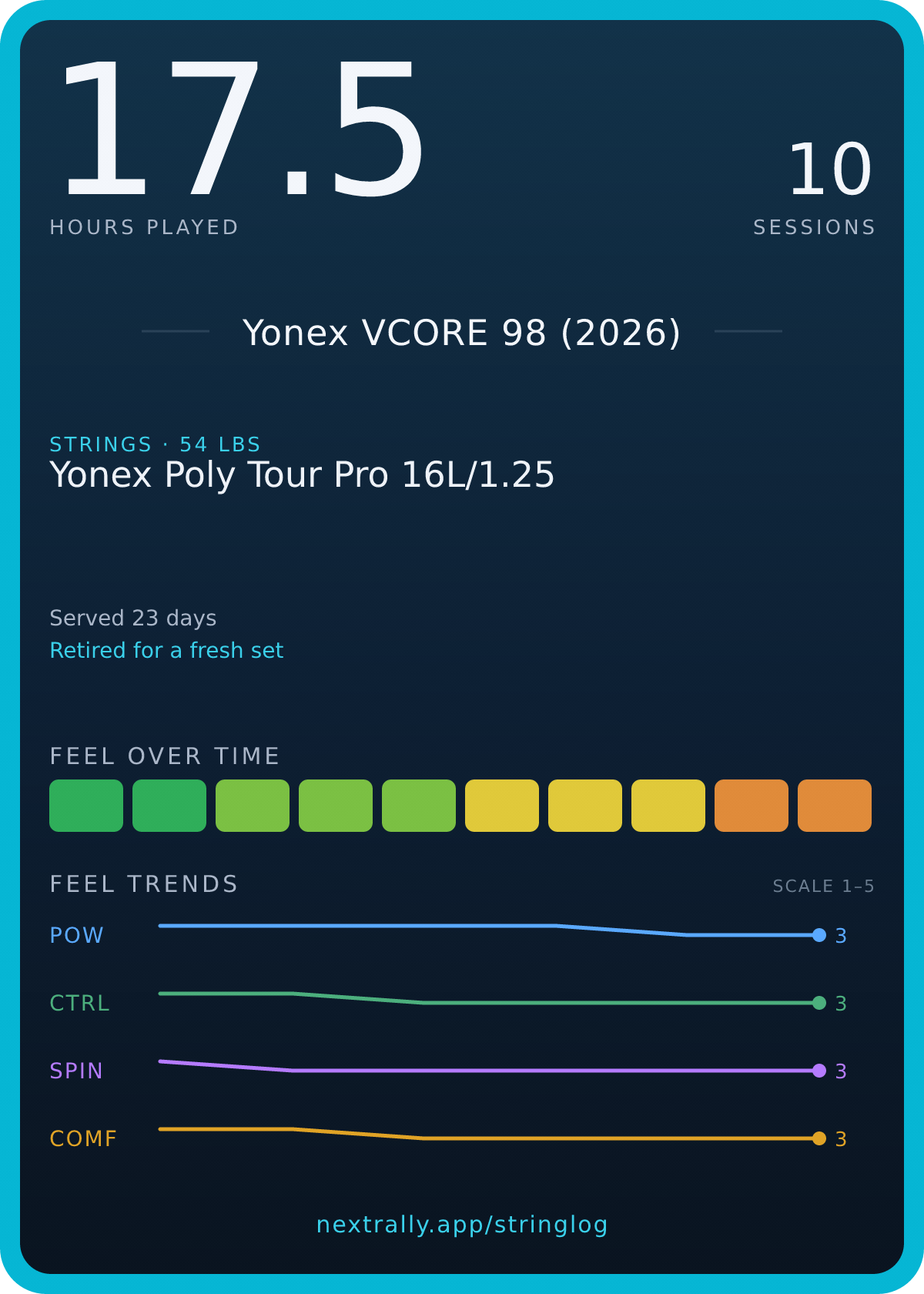
Snapback does not die during a match. It dies over weeks, and there is no moment when you feel the friction cross a line. The symptoms arrive on a delay: one day you notice you have been straightening your mains for a while, and the balls have been sailing. The trend is visible earlier if you write it down. Rate the feel after each session and the drift from crisp to boardy shows up in the numbers before the habit does. That is what StringLog is for, and starting takes one minute: log the set you are playing right now. Here is what that looks like:
So when do you actually cut them out? If you have been straightening your mains and hoping, they are probably deader than you think. When to restring is our answer, evidence included.