

How to run a tennis round robin
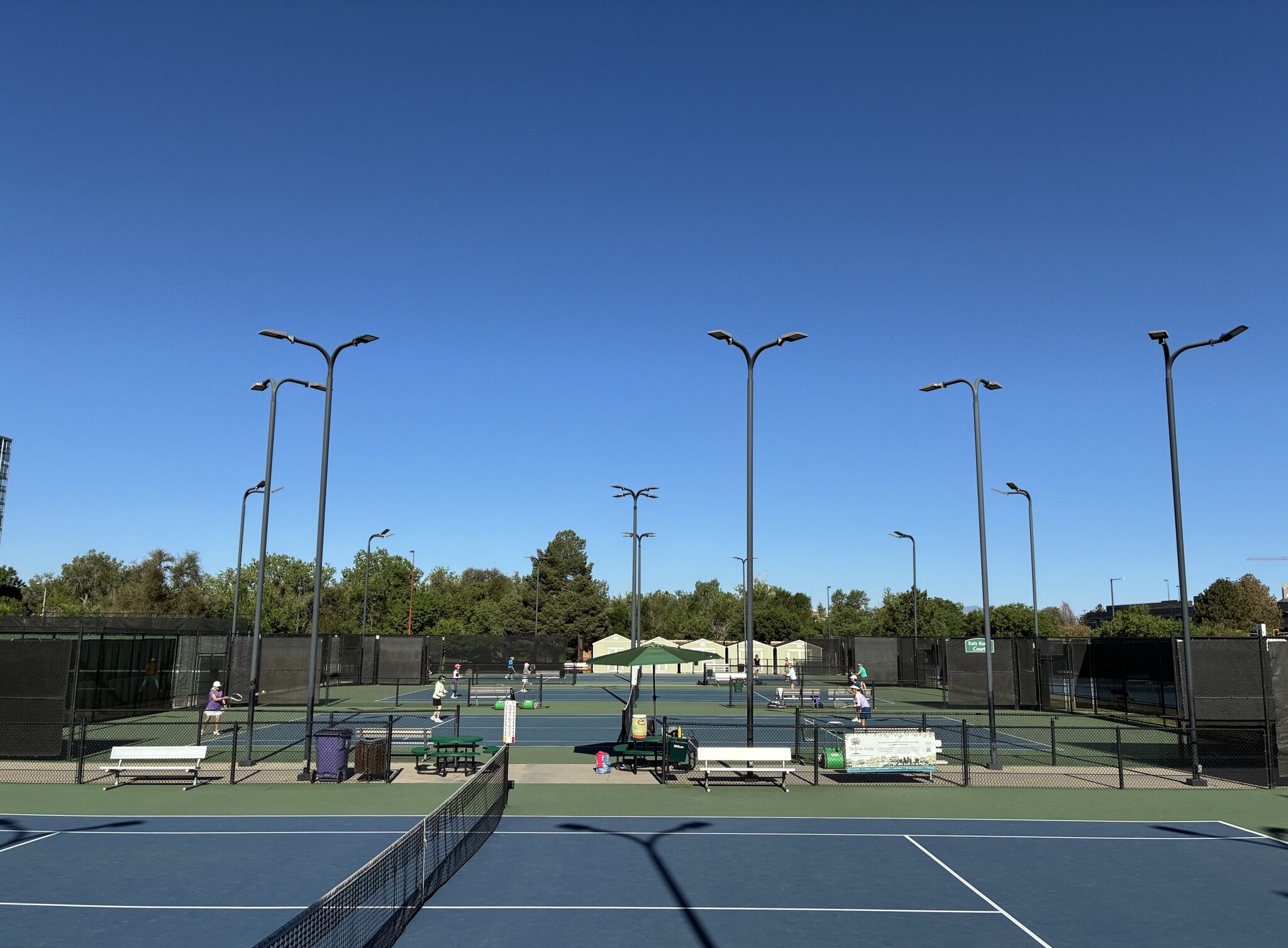
You play a lot of tennis, and you want to gather your tennis friends into a friendly social event built around playing. Or you work at a club and plan to run events to activate the community. This is the post for you.
Every club runs a round robin. It's the most fun, social format for recreational tennis and one of the best formats to grow the community. It feels casual and low-pressure to the players without giving up the competition. But running it as smoothly as players expect is the organizer's job, and the organizer is the one who carries the pressure: tracking standings, keeping the rotation smooth, and making sure the schedule doesn't bottleneck.
One format, two jobs
A round robin is the format where every entry plays every other entry once. An entry is a single player in singles, or a fixed pair in doubles. You lock partners for the whole event. (If partners rotate round to round, that's a mixer, a different format we won't cover here.) Nobody gets knocked out. Everyone plays everyone, you total the results, and the winner is whoever wins the most, with tiebreakers settling the rest.
That gives the round robin two jobs, and it's worth knowing which one you're running.
On its own, it's the whole event. Everyone plays everyone, you tally the standings, and the player on top is the champion. That works for a club night, a summer social, a one-day competition: the round robin starts and finishes the competition by itself.
As the opening stage of a bigger tournament, it's the qualifier. It doesn't crown the winner, it sorts the field. Split everyone into small groups, run a round robin inside each, and the top finishers from every group advance into a knockout bracket that decides the title. The round robin does the seeding. The bracket does the final.
Running one comes down to a few decisions:
- The N, the entry count. It's the number of players in singles, or the number of teams in doubles.
- The courts. How many courts and hours you have.
- The schedule. The rotation that has everyone play everyone, with sit-outs for odd numbers.
- The rules. Match length, scoring, and tiebreakers, all settled at the start.
- The day itself. Subs for the inevitable drop-out, and a clock to keep rounds moving.
Get those right and the format runs itself. Let's get to it one by one.
Fit it to your courts and clock
Start with the match count. A round robin is N × (N − 1) ÷ 2 matches, where N is the number of entries. We'll use singles as the example to keep it simple.
| Players (N) | Matches |
|---|---|
| 4 | 6 |
| 5 | 10 |
| 6 | 15 |
| 8 | 28 |
| 10 | 45 |
Next, the rounds. A round is a batch of matches played at the same time. With an even number of players, everyone is on court every round, and it takes N − 1 rounds to cover every pairing: each player has N − 1 opponents and meets one per round. 8 players is 7 rounds of 4 matches, exactly the schedule the generator lays out.
An odd number works the same way, with one wrinkle: one player sits out each round, and everyone sits once, so it runs N rounds, not N − 1. 5 players is 5 rounds of 2 matches, a different player resting each round. The match count doesn't change, N × (N − 1) ÷ 2 holds either way, so 5 players is still 10 matches.
Courts don't change the rounds, they change how long each one takes. Each court runs one match at a time, so a round with enough courts for all its matches plays out in one go. With fewer courts, it runs in chunks. For total time, the shortcut is matches × match length ÷ courts.
Start small: 4 players is 6 matches across 3 rounds. On 2 courts both matches in a round go at once, so if you've booked the courts for 2 hours, each round gets about 40 minutes (120 ÷ 3), plenty for a set.
Now 8 players, 28 matches, at, say, a 30-minute short set. On 4 courts: 28 × 30 ÷ 4 is about 3.5 hours. On 2 courts: 28 × 30 ÷ 2 is 7 hours; the same 7 rounds will take all day, which nobody wants. When it won't fit, add courts, shorten the matches, or, past 8 or so, split into groups that feed a knockout (more on that near the end).
Match length is the lever you'll reach for most. With courts, clock, and headcount set, pick a format to fit the time you've got:
- a full match, 2 out of 3 sets
- a pro set: first to 8 or 9 games with a tiebreak
- a regular set: first to 6 games, win by 2, tiebreak at 6-all
- a short set: first to 4 games, tiebreak at 3-all
A full match or a regular set gives you a set-by-set line (6-4, 6-3). A pro set or a short set gives you a single games count (8-5) instead, with no strict set rules, the same as timed games.
When you generate the roster with Brackets, pick the right scoring option: Standard for sets, Flexible for a straight games count. Then you enter the score players actually played.
If you're running a big group on few courts, end every court at the same time. When the first court (or first 2) finishes, everyone finishes, you score each match where it stands, and the whole field rotates together. It keeps the rounds aligned so one long three-setter can't hold up the next round, and it pairs naturally with timed games.
Whatever you pick, tell everyone beforehand, including no-ad or regular scoring. Printing the format and policies and handing them out helps.
Build the schedule
The schedule is the fiddly part: every player has to meet every other once, nobody double-booked, nobody benched more than they have to. Luckily, it's also the part you don't have to do by hand. Paste your players into the round robin generator and it lays out every round, rotating the sit-outs when your count is odd.
Here's what it produces for 8 players: 28 matches across 7 rounds, every pairing exactly once.
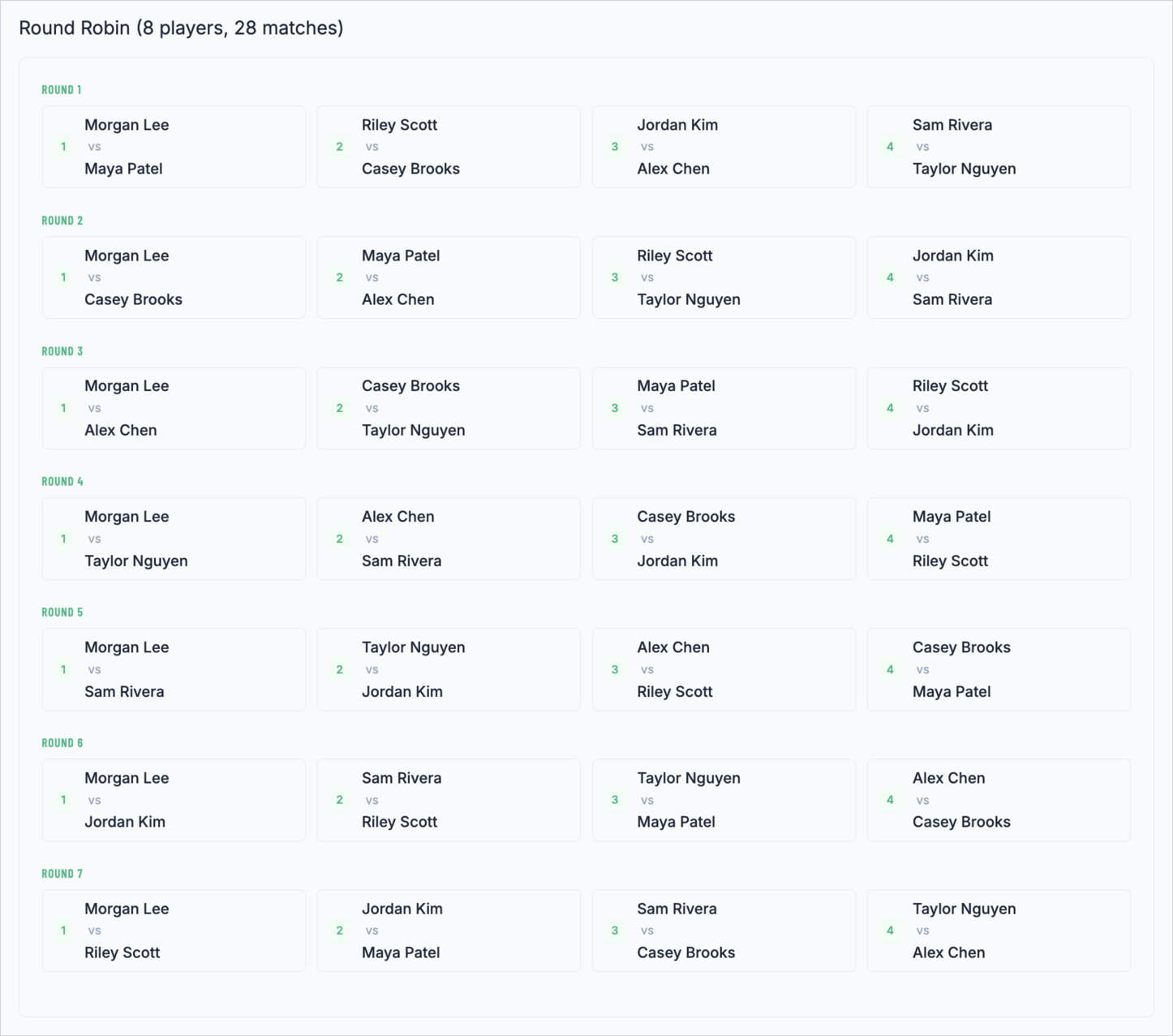
Odd numbers and overflow. Somebody usually has to sit, and how you handle it decides whether the day flows or drags. Two things put players on the bench: an odd count, and more players than your courts can hold at once. Both come down to the same fix: rotate who sits, so it never lands on the same player.
The count that fights you is a small field on a single court: 5 players is 10 matches run one at a time, with 3 players waiting through every match. If that's your situation, switch to short timed games so the bench turns over quickly. Nobody likes waiting on a tennis court.
Score it
Scoring is trivial: 1 point per win, 0 per loss, and the standings rank by total wins. The only thing left to settle is ties, and Brackets settles them by game difference: when 2 players finish level on wins, whoever won more games than they lost across all their matches ranks higher.
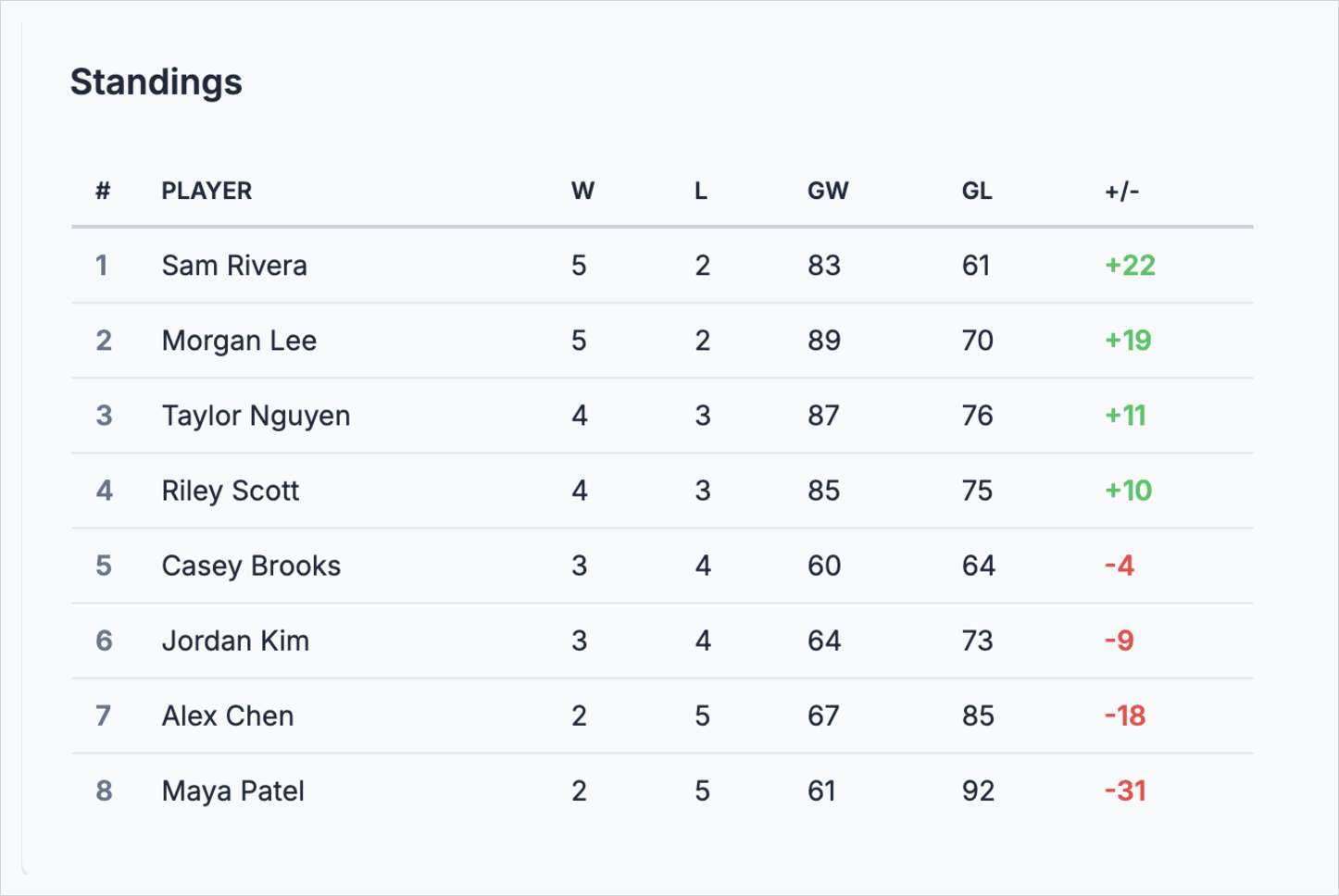
You can see it here: Sam Rivera and Morgan Lee both finished 5-2, and Sam Rivera lands on top because the game difference is better, +22 to +19. Tell players the order before they start, wins then game difference, so nobody's surprised when the trophy comes out.
On the day: drops, subs, and late arrivals
The round robin is brittle. The entire grid is built for one exact headcount. Drop a player from an 8-player round robin, you're rebuilding the schedule on the spot while the other 7 stand around waiting on you. So it's always better to line up 2 players who'll take a spot if someone bails. A sub steps into the dropped player's place and plays out their remaining matches. No massive sudden schedule change.
On the day, if someone drops mid-event and no sub takes over, use the scoring fix: record their unplayed matches as a default win for each opponent. Nobody's standing gets wrecked by someone else's exit, and the grid logic holds. In Brackets, a default counts the win with no games, while a score like 6-0 counts the win and the game difference, so either keeps the standings right.
Late arrivals are the easy case. As long as they make their first scheduled match, they slot straight into the grid. Give players a 10-minute grace before you call a no-show and reach for the sub.
The rest of what goes wrong on the day isn't schedule math. It's people. A line call gets disputed on a no-ad deciding point and the whole court stops. Settle the no-ad rule and who picks the side before the first serve, so there's nothing to argue about. A round drags because a pair won't stop talking between games, which is exactly what the same-time finish reins in.
Scale it up: the group stage
For 8+ entries, one big round robin is too many matches for a day, and this is where the format's second job earns its keep. Don't try to stretch the schedule, split the field instead. Put players into small groups, run a quick round robin inside each, then send the top finishers into a knockout that decides the title.
Here's a shape that fits an afternoon: 4 courts, 3 hours. The first 2 hours are group round robins. The top 2 from each group move into a one-hour knockout for the championship, and the 3rd and 4th seeds drop into a consolation bracket so nobody's afternoon ends at the halfway point. Then a barbecue, and the club champion gets crowned at it.
The math is why it works. A group of 4 is 6 matches, so 4 groups of 4 is 24 matches for 16 players, against 120 for one giant round robin. You keep the everyone-plays-everyone fairness inside each group, you get the drama of a knockout to finish, and the whole thing fits an afternoon. The group results seed the bracket, so the knockout isn't a blind draw. Players earn their spots on the court.
This is where Brackets does the work twice: it runs each group's round robin and standings, then builds the elimination or consolation draw the top finishers feed into.
Make it a party
The best round robins aren't really about who wins. They're about the people, the community, the tennis energy. Run it as an event: set up a barbecue and some drinks at the end, and crown the winner in front of everyone.
The competition gives the day a spine, but the party is why players sign up again next season. A round robin is one of the cheapest ways a club has to pull its members together, and the trophy is mostly the excuse.