

How to run a tennis doubles mixer
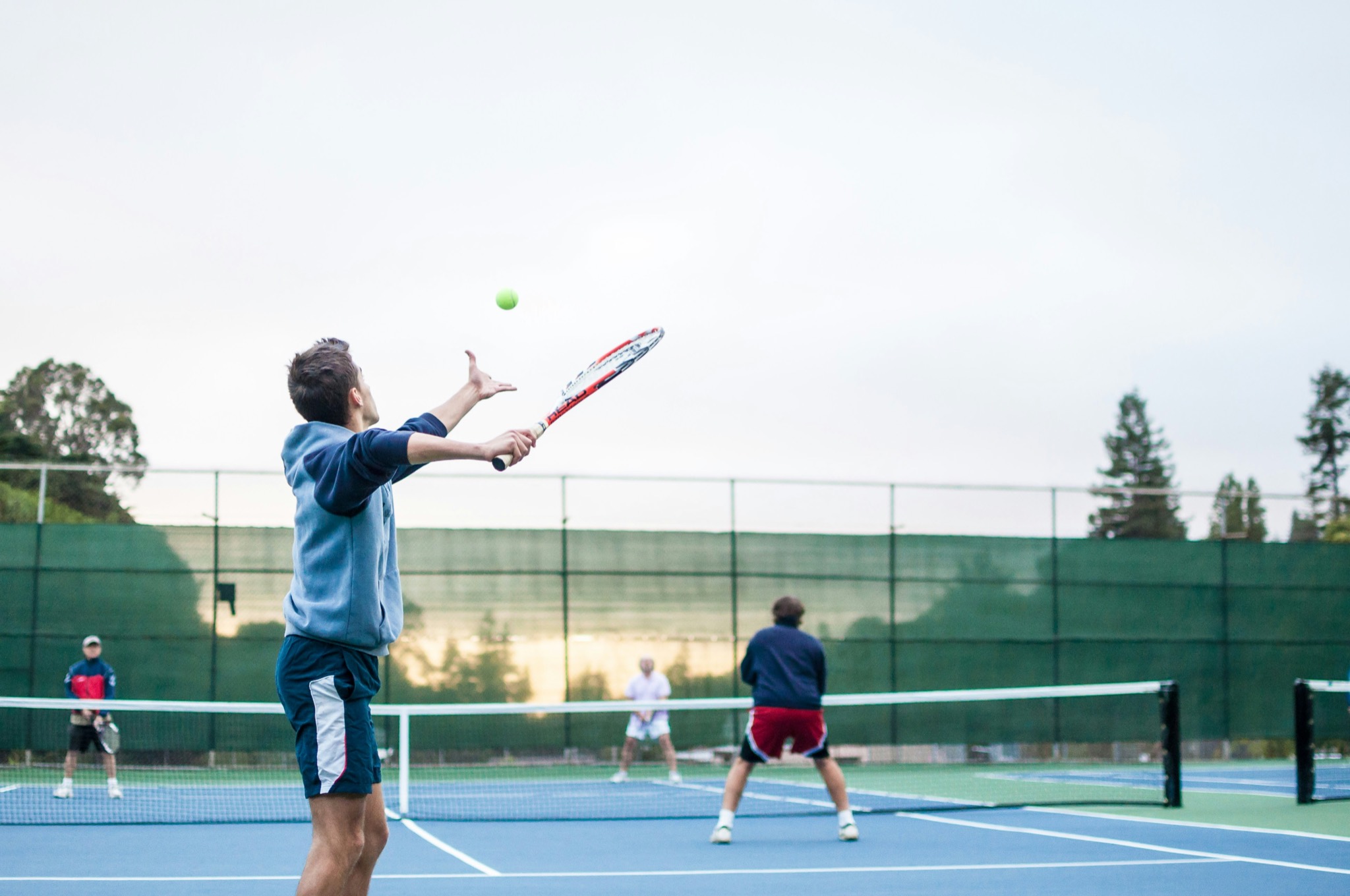
Photo by J. Schiemann on Unsplash
There's a recreational social doubles format that's easy for any player to drop into, without a big change to how your open play already runs. As a club organizer, you know players don't want to lock in with a stranger for a whole event the way a round robin does. You want to encourage socializing without stressing anyone out. The doubles mixer is the format for you: flexible, dynamic, and relaxed. Scores stay on the court, nothing to take home or put on the wall.
What a mixer is, and how it differs from a round robin
A doubles mixer is a format where your partner changes every round. Each round you're paired with someone new, so you play alongside a different person each time instead of locking one partner for the whole event.
That's the line that separates it from a round robin. In a doubles round robin you team up with one player for the whole event, and that team plays every other team once; in a mixer you partner everyone once, ideally. What it doesn't promise is that players face each other an equal number of times; it balances partners, not opponents. How cleanly that lands depends on the headcount, which is the next thing to sort out.
Fit it to your courts and clock
Start with the partnership count. With N players, the number of partnerships is N × (N − 1) ÷ 2. Each match puts two of those partnerships on court, four players in all, so the number of matches is roughly that figure divided by two again, about N × (N − 1) ÷ 4. That tells you how much tennis your event holds before you book a single court.
A mixer runs cleanest when the player count is a multiple of 4, so 4, 8, 12, or 16. At those numbers everyone is on court every round, nobody sits out waiting, and every player partners every other exactly once. Take 8 players. That's 28 partnerships and 14 matches, played across 7 rounds, and each player gets 7 different partners over the event. The arithmetic lands evenly, which is exactly what you want from a social format. Here's how the clean counts scale:
| Players (N) | Partnerships | Matches | Rounds |
|---|---|---|---|
| 4 | 6 | 3 | 3 |
| 8 | 28 | 14 | 7 |
| 12 | 66 | 33 | 11 |
| 16 | 120 | 60 | 15 |
Sixteen players is the ceiling for a single mixer in the generator. It's a practical ceiling, not just a software one: past 16, a single mixer needs more courts and more time than most club sessions have room for. If more than 16 turn up, split them into separate mixers of up to 16 each and run those in parallel, one generated schedule per group.
Other counts still work, they just don't divide as neatly. Any number that isn't a multiple of 4 leaves someone sitting each round, which we come back to below. A few counts have one quirk worth knowing about: at 6, 7, 10, 11, 14, or 15 players, the math forces a single pair to never share a court, even though everyone else still partners everyone once. It's a small gap, and it's built into the format at those counts rather than a miscount in your roster, so if you're at one of those numbers, expect exactly one duo to miss each other.
Match length is the lever you adjust to fit the clock, and it's a genuine trade-off. The full schedule is long by nature: 8 players means 7 rounds, so whatever match length you pick, multiplied by 7, is roughly your whole session. It's tempting to shrink each match until the rounds fit the court time, but cut too far and nobody really gets to play.
You could do a short set, first to 4 games, or a timed round of 20 minutes. Any of those lets a pairing settle in while still keeping the rotation moving; at that length, 7 rounds runs roughly 2.5 hours once you allow for changeovers. If that won't fit the time you have, play fewer rounds of quality matches rather than running all 7 as sprints; everybody having fun matters more than getting through every round.
If you run timed games, agree before the first serve how a game settles when the buzzer cuts it off; the round robin post covers the set-versus-timer trade-offs in full.
Build the schedule
Don't bother drawing up the partner rotation by hand. Keeping every pairing straight while making sure each player partners everyone exactly once is fiddly. Paste your players into the doubles mixer generator and it lays out every round for you, rotating partners so each player teams up with as many different people as the headcount allows, everyone once when the numbers divide cleanly.
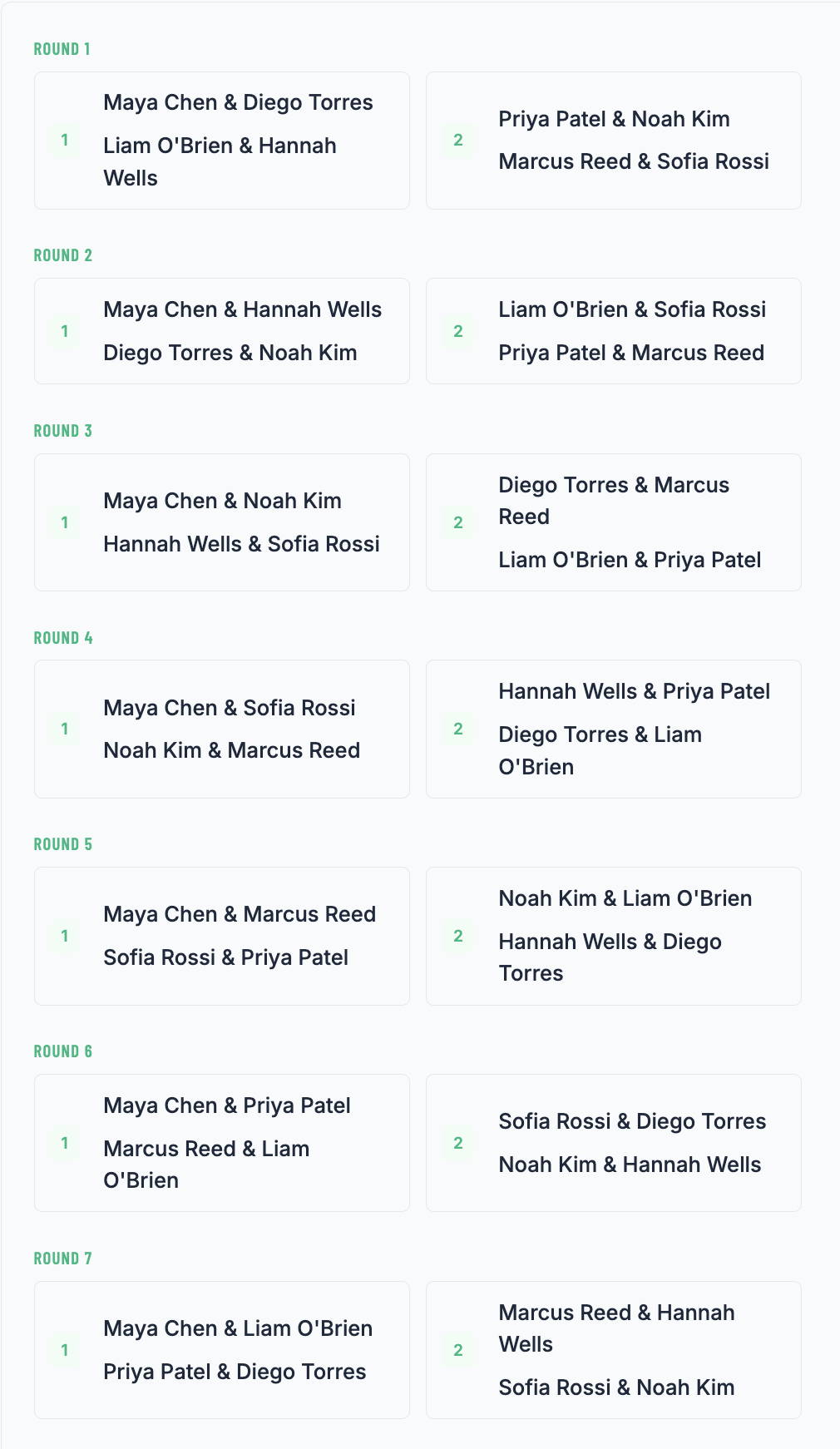
When the player count isn't a multiple of 4, some people have to sit a round out. The generator handles that too: it rotates the sit-outs so the same players aren't the ones benched every time, and it spreads the rest across the field as evenly as the numbers allow.
Score it
In Brackets you score a mixer match the same way you score any match: tap the match, set the winning pair and the games they won, and it saves to the bracket. The catch is what comes next. Because partners change every round, a team exists for the length of one round and then dissolves, so a table of team results would rank pairings that shared a court once and never again.
If you want a per-player ranking, which Brackets doesn't tally for you, you'd need to do it manually: a column per player on a sheet, and as each round finishes, add the games that player won to their running total. Whoever has won the most individual games over the event finishes top. If you'd rather score by points than games, total the points the same way; the principle doesn't change.
On the day: drops, subs, and late arrivals
The schedule is built for an exact headcount. Losing a player on the day does have an effect. If someone pulls out and you have a sub ready, drop the sub into that player's spot and nothing else changes; the rotation is built by position, so a straight swap keeps every round running as printed.
If no sub is available, be honest with yourself that there's no perfectly tidy fix. Before the event starts you can just regenerate for the smaller group, and the sit-outs come out spread evenly.
Once play is under way it's trickier: regenerating starts the pairings over and clears the results you've already entered, so the better move mid-event is to keep the printed schedule running and have the short-handed matches borrow whoever is sitting out that round. You give up a little of the everyone-once neatness, but the event holds together and your tally stays intact.
Late arrivals follow the same logic. If they're there before the first round, add them and regenerate so the rotation accounts for them from the start. If play is already under way, adding a name means the same redraw that resets the pairings, so it's usually smoother to fold them in by hand: slot them in wherever someone would otherwise sit, and let the printed schedule carry on. Either way, get them in early, while the rotation still has room to absorb them.
Make it a regular event
No format beats a doubles mixer for turning casual players into regulars and getting everyone on court more often. It's relaxed and social, not a serious tournament, so there's little to stress about. Run it again as soon as you have the court time.