

How to run a tennis compass draw
Photo by Julius Hildebrandt on Unsplash
The compass draw doesn't come up as often as the round robin or the doubles mixer, but it solves a problem every club organizer knows: in a straight knockout, half the field loses once and is gone before lunch. A compass keeps them playing. It runs like a normal bracket, but a loss doesn't put you out; it moves you into another draw, each named for a compass point, where you play on. Everyone gets a full day of tennis, not just the ones who win early.
If you want everyone to play each other rather than compete in brackets, take a look at the round robin instead. For a format that rotates partners and keeps things social, there's also the doubles mixer. The compass draw is for the days when you want a bracket, a champion, and nobody sitting idle.
Here's how to set one up.
What a compass draw is, and how it differs from single and double elimination
The main draw in a compass draw is the East bracket, a standard single elimination. Players seed in, win and advance, and a loss drops them into one of the consolation draws, West, North, South, and so on, instead of sending them home.
At 8 players there are 4 brackets, East plus West, North, and South; at 16 you add 4 corner brackets, Southeast, Northeast, Southwest, and Northwest. Each direction runs its own bracket to its own final.
The real difference from single elimination is this: a player who loses once in a single elimination bracket is out; a player who loses once in a compass draw drops a direction but keeps playing. Single elimination can soften the blow with an optional consolation bracket, but that only rescues first-round losers; the compass catches losers from every round, so someone knocked out in a later round still has a direction to play for. Every player is guaranteed at least 2 matches, win or lose.
If you've run a double elimination, a compass works on the same idea. Both crown one champion, and in both a single loss doesn't end your day. The difference is where you land: double-elim has the one loss bracket, while a compass gives every loser a direction to go play in, round after round. Double-elim also handles more than 16 players, where a compass tops out, so it's the one to reach for with a bigger turnout.
Fit it to your courts and clock
A compass draw runs with 5 to 16 players. It runs cleanest at 8 or 16:
| Players (N) | Directions | Matches each | Total matches |
|---|---|---|---|
| 8 | 4 (E/W/N/S) | 3 | 12 |
| 16 | 8 (+SE/NE/SW/NW) | 4 | 32 |
At 8 you get 4 directions, 3 matches per player, 12 total. At 16 you get 8 directions, 4 matches per player, 32 total. Those are the counts where the arithmetic lands evenly and the bracket fills without gaps.
Any count from 5 to 16 works. Counts that aren't 8 or 16 use byes and a back-draw to absorb the odd numbers, so every player still gets at least 2 real matches. It's just less even than the clean sizes. Below 5, that two-match guarantee doesn't hold; above 16, the generator caps out, since the compass is built as an 8 or 16 player draw. For a bigger turnout, reach for double elimination instead, as covered above.
Because everyone keeps playing instead of getting knocked out, you'll need enough courts and time to handle it. An 8-player compass is 3 rounds (16 players is 4), and every round puts all 8 players on court at once, so you want 1 court for every 2 players: 4 courts for 8, 8 for 16. With that many, nobody waits; the event runs as one continuous session of 3 rounds, roughly a couple of hours with short sets.
For how long to make each match, the round robin post covers sets versus a timer in full.
Build the draw
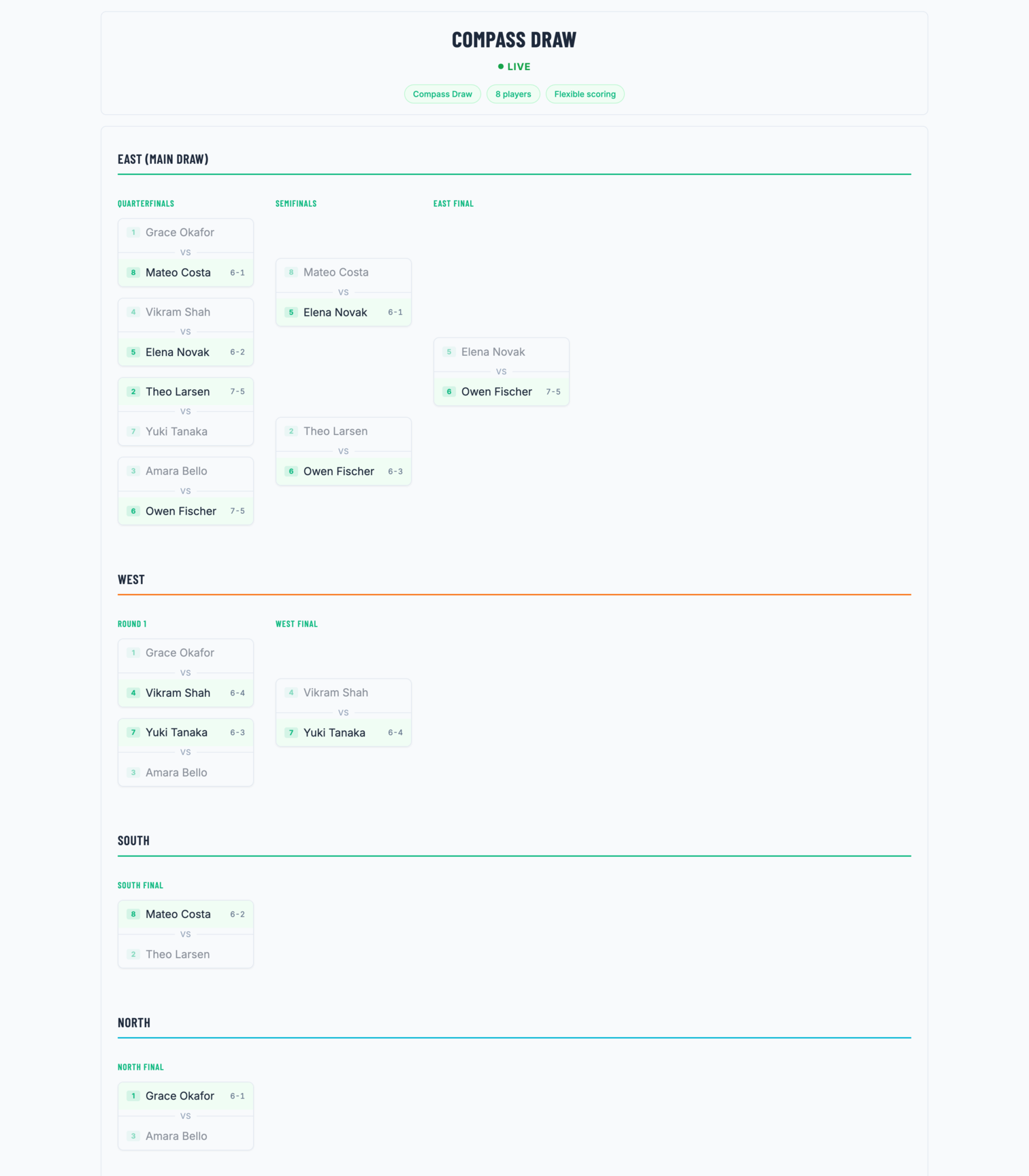
Don't wire the directions by hand. Paste the players into the compass draw generator and it does the planning for you: it seeds the East draw, places byes where the headcount needs them, and routes each winner and loser into the correct direction bracket (and into the back-draw for counts that aren't a clean 8 or 16). You get the full bracket ready to run.
Who wins
The East final winner is the overall champion. East is the main draw, so that's the title match. The winning slot is highlighted in the bracket view.
Every other direction crowns its own winner too. The West final, North final, South final: each one produces a direction winner. At 16 players you also get a Southeast final, Northeast final, Southwest final, and Northwest final, each with its own winner. A player who drops into West after losing round one can still win that bracket's final. Everyone has something to play for to the last match.
There's no totaling or standings math involved. Unlike a round robin or a mixer, you don't add up games or points across the event. You just play each bracket to its final, and the last player standing in each direction wins it.
On the day: byes and drops
Always regenerate the draw if the headcount shifts before the first match. Odd counts and in-between numbers are absorbed automatically by byes and the back-draw. Just paste the updated roster into the generator and it re-seeds everything before play starts.
A mid-event drop is simple. The scoring supports walkover, retirement, and default (W/O, RET, DEF) for matches that end early or never start, or you can replace the player who dropped out with a bye. You don't need to line up subs for a compass draw.
Since a compass draw runs several brackets at once, the real on-the-day job is keeping every court's result current so the next round can fill. It helps to have someone else on scores so you can keep the event moving; add them as a co-host and they can enter results too. Share the bracket link with the players, and they get a live scoreboard they can follow from their phones.
Make it a regular event
A compass draw makes a good monthly club championship. You still crown a real winner, but nobody's done after one match; the players who lose early are off playing for a West or South final, something with their name on it. When you want a bracket and a champion without sending half the field home early, this is the one to run, and it tends to become the event people ask you to repeat.