

How to run a double elimination tennis tournament

Photo by Matteo Max Putzolu on Unsplash
Say you want a competitive tournament where one bad match doesn't send a player straight home. There are two ways to get there: a double elimination draw, or a single elimination draw with a consolation bracket turned on. They look similar at a glance; both run a second bracket alongside the main draw. But they are not the same tournament, and the difference is who actually gets that second chance.
How double elimination runs
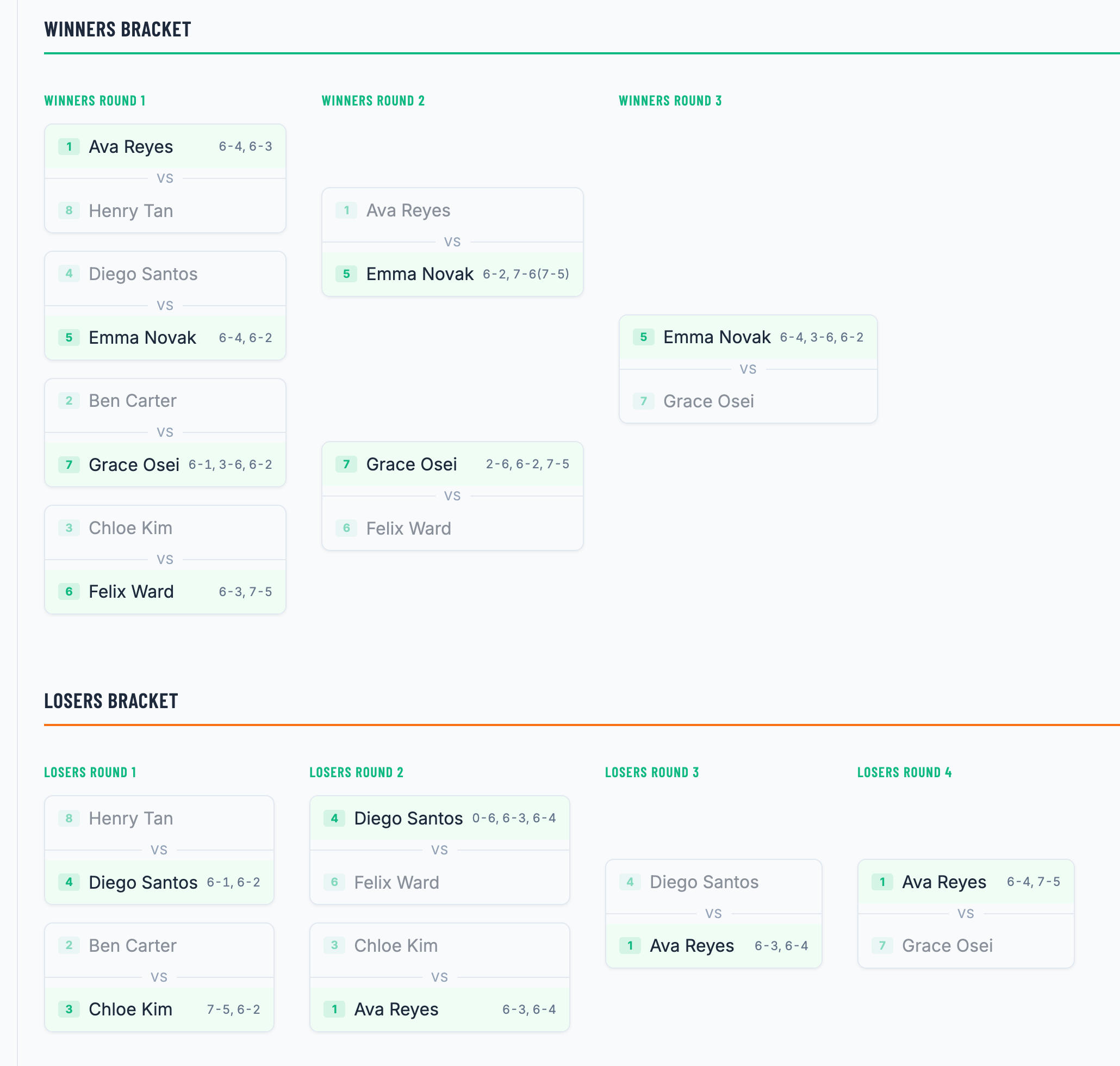
Both double elimination and single elimination with consolation start from the same main draw: an ordinary single-elimination bracket. Each then adds a second bracket on top. Single elimination adds a consolation bracket off to the side; double elimination keeps the draw as the winners bracket and adds a losers bracket right beneath it.
In double elimination, the winners bracket thins out, and the losers bracket fills up behind it, then thins as second losses knock people out. Brackets routes every loser to the right slot automatically, so nobody has to trace the lines by hand. Eventually each bracket has one player left, the winners champion and the losers champion, and those two meet in the grand final.
The grand final, and why there's sometimes a reset
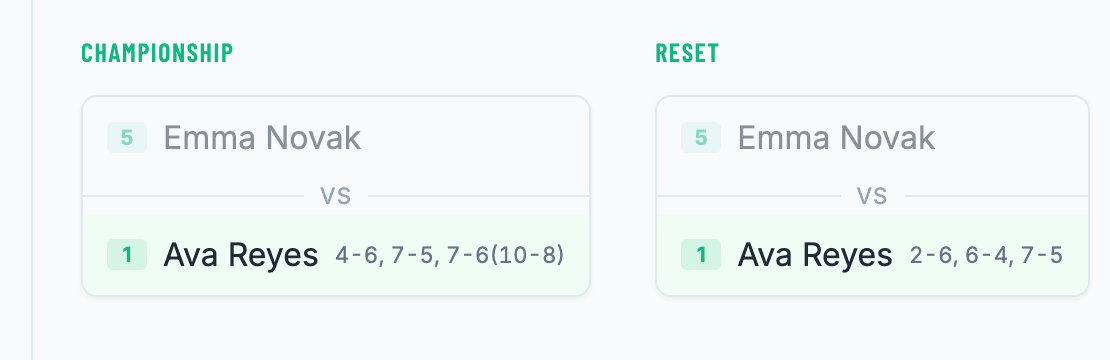
The winners champion reaches the grand final without losing a match. The losers champion reaches it with one early loss. They're not even, and the grand final is built to settle that fairly.
The grand final can be one match or two:
- If the winners champion wins, they hand the losers champion a second loss. That's it, tournament over.
- If the losers champion wins, both players now have exactly one loss. Nobody has two yet, so it isn't settled. Those two play one more, the reset match, and its winner is the champion.
The match count is high in double elimination
Double elimination runs roughly double the matches of a regular single elimination: 2N − 2 to 2N − 1 for N players. An 8-player draw is 14 or 15 matches, the 15th being the reset, where a single-elimination 8-player draw is 7.
So plan for it. More matches means more court time and a longer day, and the losers bracket can't be fully scheduled up front because it depends on who loses in the winners bracket. If you're tight on courts or daylight, that's the thing to weigh before you pick this format.
Key ways double elimination differs from a consolation bracket
Single elimination with consolation is truly two separate tournaments: the main draw, plus a small side event that exists so first-round losers get more than one match. For a player who loses round one and then loses again, the two formats feel identical; they're out either way. Everywhere else, they differ.
Who gets a second chance. In single elimination with consolation, only round one losers drop into the consolation bracket. A player who wins the first match but loses later, in round two or any round after, is out after a single loss. That's the classic consolation irony: the player who loses the main-draw semifinal goes home while someone who lost immediately in round one is still out there playing. In double elimination, a loss at any stage drops a player into the losers bracket instead, so that semifinal loser is still alive, and arguably in a strong position.
What the second chance is worth. In single elimination, the consolation winner gets a side prize; they can't become tournament champion. In double elimination, the losers bracket still feeds the grand final. A player who lost their opening match can, in principle, run the whole losers bracket, beat the undefeated player twice (grand final plus the reset), and win the tournament.
Match load. A consolation run is short, because that bracket is sized to half the round one field. The losers bracket is long: an 8-player draw has 3 winners-bracket rounds but 4 losers-bracket rounds, so a round one loser can end up playing more matches than the champion does.
Is double elimination the format you actually want?
Worth a straight answer, because double elimination isn't the only way to give players more tennis.
If your goal is a reliable champion for a competition that matters, and you can spend the matches, it's an excellent choice.
If the real goal is just "everyone should get more than one match," there are lighter formats built for exactly that. A compass draw guarantees everyone several matches without the two-bracket bookkeeping.
A note on expectations: USTA tennis almost never runs double elimination, so if you're after a sanctioned-feeling format, a compass or feed-in consolation draw is the closer fit.
Whichever way you lean, Brackets does the bookkeeping: it builds the winners bracket, routes every loser into the losers bracket, and adds the reset only when the final calls for it. The setup is a couple of minutes. You set the draw and referee the tennis. The extra matches buy you one thing worth having: a champion nobody in the room calls lucky.